Best Air Purifier: 9 Expert Picks for Cleaner Indoor Air
The best air purifier is the one whose smoke CADR fits your room. For bedrooms and living rooms up to about 360 sq ft, start with the Coway Airmega Mighty. Choose the Levoit Vital 200S for pets, the Winix 5510 for app control, and the Winix 9800 or Coway Airmega ProX for large, open rooms.
How we choose: our picks use manufacturer specifications, AHAM Verifide and ENERGY STAR data, and published independent tests. Air Purifiers Hub has not run its own lab tests on these models, and we do not recommend ozone generators as a main purifier.
Top picks at a glance
Picks run from small rooms to extra-large spaces. CADR is in CFM. Room sizes at 4.8 ACH are manufacturer-stated, except those marked ≈ (calculated as CADR × 1.55).
| Model | Best for | Smoke CADR | Room at 4.8 ACH | Price |
|---|---|---|---|---|
| Coway Airmega 100 | Small rooms, desks | 108 | 167 sq ft | $129.99 |
| Coway Airmega Mighty | Most bedrooms, living rooms | 234 | 361 sq ft | $239.99 |
| Levoit Vital 200S | Pets, app control | 250 | ≈388 sq ft | $169–189 |
| Winix 5510 | Value, smart features | 253 | 392 sq ft | $180–260 |
| Levoit Core 400S | Large bedrooms | See note | 358 sq ft | $219.99 |
| Honeywell HPA300 | Large rooms, no app | 300 | 465 sq ft | Check retailer |
| Coway Airmega 350 | Large open rooms | 352 | ≈546 sq ft | $245–339 |
| Winix 9800 | Large rooms, smart | 336 | 522 sq ft | $279–329 |
| Coway Airmega ProX | Extra-large spaces | 596 | ≈924 sq ft | $667–999 |
Core 400S note: ENERGY STAR's certificate lists 358 sq ft for this model, while older Levoit material lists 260 CFM and 403 sq ft. Confirm certified figures in the AHAM directory. Want a side-by-side view?
Which air purifier fits your room?
- Under about 165 sq ft: Coway Airmega 100.
- Up to about 360 sq ft: Coway Airmega Mighty.
- Pets, up to about 390 sq ft: Levoit Vital 200S.
- About 360 to 400 sq ft with an app: Winix 5510 or Levoit Core 400S.
- About 465 to 520 sq ft: Honeywell HPA300 (no app) or Winix 9800 (app).
- 500 sq ft and up, open layouts: Coway Airmega 350 or ProX.
Browse by need: HEPA air purifiers, allergy and pet air purifiers, large room air purifiers, and quiet bedroom air purifiers.
The 9 best air purifiers for home: our reviews
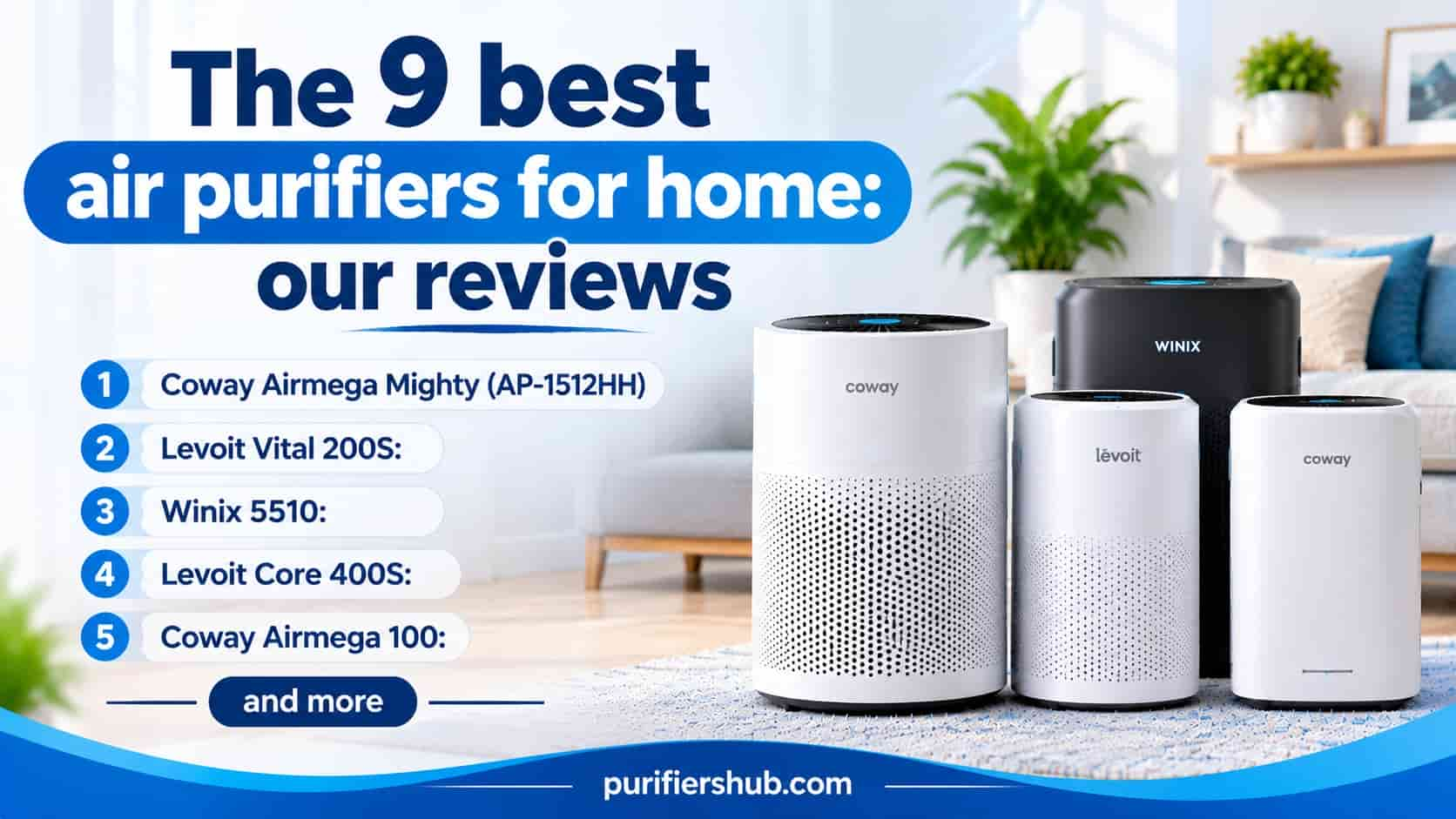
1. Coway Airmega Mighty (AP-1512HH): best for most bedrooms and living rooms
Coway lists CADRs of 234 (smoke), 248 (dust) and 232 (pollen) CFM and a 361 sq ft room rating at 4.8 air changes per hour. Air passes through a pre-filter, a deodorization filter, a True HEPA filter and a bipolar device; Coway rates the deodorization filter at about six months and the HEPA filter at about a year. Noise runs from roughly 24 to 54 dB(A), maximum power use is 77 W, and the list price is $239.99. Coway also sells a newer Mighty2 (AP-1512N, $269.99) without the ionizer.
Suits: bedrooms, apartments and offices up to about 360 sq ft. Not for: larger rooms, or anyone avoiding ionizers. Read the full Coway Airmega Mighty review → For all Coway models compared, see our Best Coway Air Purifier guide.
2. Levoit Vital 200S: best for pet owners and app control
Retailer listings show AHAM Verifide CADRs of 250 (smoke), 254 (dust) and 289 (pollen) CFM, about 388 sq ft at 4.8 air changes. Levoit's own store page lists a slightly lower 242 CFM, so treat 388 sq ft as the ceiling. A U-shaped extra inlet is meant to catch pet hair, Pet Mode alternates fan speeds, and the VeSync app handles schedules. Typical price is $169.99 to $189.99. Levoit's filter wording varies between listings ("HEPA-grade" in some), so read the label on the exact unit you buy.
Suits: pet households and anyone who wants app control. Not for: shoppers who need a certified True HEPA label. Read the full Levoit Vital 200S review →
3. Winix 5510: best value with smart features
Winix lists AHAM-verified performance for 392 sq ft, with smoke, dust and pollen CADRs of 253, 252 and 247 CFM. It combines a washable pre-filter, True HEPA, activated carbon and PlasmaWave (Winix's ionization feature, which can be switched off), plus Wi-Fi app control and an auto mode with an air-quality sensor. ENERGY STAR certified. Noise runs about 23.5 to 54 dB(A), and typical prices run $180 to $260. The 5520 is the same machine with a different front panel.
Suits: medium to large bedrooms and living rooms. Not for: light sleepers who would run it on high. Read the full Winix 5510 review →
4. Levoit Core 400S: best smart purifier for large bedrooms
ENERGY STAR certifies the Core 400S and lists a room size of 358 sq ft. It adds app and voice control and a built-in air-quality sensor, with noise up to 52 dB, 38 W power use and a $219.99 price. One review puts a replacement filter near $50. Levoit sells close variants (400S and 400S-P), so check the exact model name before you buy.
Suits: large bedrooms and living rooms that benefit from scheduling and auto mode. Not for: rooms above about 360 sq ft. Read the full Levoit Core 400S review →
5. Coway Airmega 100: best for small rooms
Coway's spec sheet lists CADRs of 108 (smoke), 124 (dust) and 112 (pollen) CFM and 167 sq ft at 4.8 air changes. The 810 sq ft figure on the box assumes one air change per hour. A 3-in-1 filter (pre-filter, HEPA and deodorization) is rated for 12 months, noise runs 20 to 48 dB(A), power use is 25 W, and Coway lists it at $129.99 with a $39.99 replacement filter.
Suits: a dorm, nursery or small office. Not for: rooms over about 165 sq ft.
6. Winix 9800: best large-room pick with app control
Winix lists AHAM-verified performance at 522 sq ft (4.8 air changes) and retailer listings show a smoke CADR of 336 CFM. It has a four-stage system with True HEPA, carbon and PlasmaWave, Wi-Fi control, a 26.2 dB minimum noise level, and about 95 W power use. CARB and ENERGY STAR certified, two-year warranty. Typical prices run $279 to $329.
Suits: large living rooms and open bedrooms. Not for: small rooms, where it is more than you need.
7. Honeywell HPA300: best large-room unit without an app
Honeywell's listing cites AHAM-rated CADRs of 300 (smoke), 320 (dust) and 300 (pollen) CFM for rooms up to 465 sq ft. It uses a True HEPA filter with an activated-carbon pre-filter. Honeywell recommends replacing the HEPA filter about once a year and the pre-filter about four times a year. ENERGY STAR certified. You set its four speeds by hand — no app, no auto mode.
Suits: a large room where you want strong airflow and a simple filter schedule. Not for: anyone wanting auto mode or an app.
8. Coway Airmega 350: best for large open rooms
Coway lists CADRs of 352 (smoke), 376 (dust) and 450 (pollen) CFM and 2,640 sq ft at one air change per hour — which works out to roughly 546 sq ft at 4.8 (our calculation). Noise runs about 21.5 to 54.7 dB(A), maximum power use is 62 W, and typical prices run $245 to $339. A pre-filter, activated carbon and HEPA filter are rated for about a year.
Suits: open living areas and large bedrooms. Not for: small rooms.
9. Coway Airmega ProX: best for extra-large spaces
Coway's spec sheet lists CADRs of 596 (smoke), 580 (dust) and more than 450 (pollen) CFM, 1,063 sq ft at four air changes — about 924 sq ft at 4.8 (our calculation). It runs at 23 to 46 dB(A), draws 9 to 65 W, and uses a Max2 filter rated at a year or more. cETL, ENERGY STAR and CARB certified. List price $999; typical prices $667 to $999. Weighs about 51 lb.
Suits: very large, open spaces. Not for: small or medium rooms, where a smaller unit does the same job for much less.
How to choose the best home air purifier
Match CADR to your room
AHAM and the Washington State Department of Health suggest a smoke CADR of at least two-thirds of the room's floor area for 8-foot ceilings. Higher ceilings need a higher CADR.
| Room area | Min. smoke CADR |
|---|---|
| 100 sq ft | 67 |
| 150 sq ft | 100 |
| 200 sq ft | 133 |
| 300 sq ft | 200 |
| 400 sq ft | 267 |
Read the air-change footnote
Brands quote coverage at different air-change rates, so the biggest number is not a room size. The Coway Airmega 350 lists 2,640 sq ft, but that assumes one air change an hour. Coway lists the Mighty at 1,748 sq ft at one air change and 361 sq ft at 4.8. Compare models at the same rate, as in the table above.
Understand the filter claims
A HEPA filter is designed to capture at least 99.97% of 0.3-micron particles. "True HEPA" is a marketing label, and "HEPA-grade" or "HEPA-type" are different claims. Activated carbon targets odors and some gases rather than particles. For a high-performance air purifier, look at CADR first, then filter quality.
Check ozone, ionizers and plasma
EPA advises avoiding air cleaners that intentionally produce ozone, a lung irritant. Among our picks, the Mighty has a bipolar device and the Winix 5510 and 9800 have PlasmaWave (which can be switched off). Check the model's listing in the CARB or AHAM directory before buying.
Add up running costs and noise
Filters decide the real cost. Honeywell suggests a yearly HEPA filter plus quarterly pre-filters. Coway rates filters at 6 to 12 months depending on the model, and the Airmega 100's filter was listed at $39.99. ENERGY STAR estimates certified room air cleaners save roughly $18 to $40 a year. Manufacturers usually quote noise on the lowest setting, so expect more on high.
Verify certifications
AHAM says a model missing from its Verifide directory has not been independently certified, so look up each finalist. Spec conflicts are common; one retailer listing may show a different CADR than the manufacturer's page, and certified numbers can be lower than box claims. Use our compare tool to review finalists side by side.
Air purifiers we do not recommend as your main purifier
Ozone generators are sold to remove odors, but EPA advises against intentional ozone in occupied spaces. Some also cannot be shipped to California because of its air-cleaner rules. We cover them for safety context only. For everyday home use, start with a HEPA-based unit sized by CADR.
How we evaluated these air purifiers
We compared published CADR and room-size ratings, certifications (AHAM Verifide, ENERGY STAR, CARB), filter life and cost, noise and power figures, and independent tests from outlets such as HouseFresh, AirPurifierFirst and Consumer Reports. We have not run our own lab tests. Where sources disagree, we say so and use the manufacturer or certification figure. Consumer Reports member surveys rate Coway and Blueair highly for predicted reliability, and Honeywell above average for reliability. Prices move often; affiliate links never decide which models we list or how we order them.
What air purifiers can and cannot do
Portable air cleaners reduce airborne particles; they do not remove every pollutant, and they do not fix the source of mold or ventilation problems. EPA says a portable air cleaner by itself is not enough — reducing pollution sources and ventilating still matter. EPA also says several studies of portable HEPA cleaners show small improvements in cardiovascular and respiratory health, and multiple studies show improvement in one or more allergy or asthma symptoms. An air purifier is not a medical treatment, so talk to a clinician about asthma or allergies.
Our verdict
For most homes, the best air purifier is the Coway Airmega Mighty — with the Levoit Vital 200S for pets, the Winix 5510 for value, and the Winix 9800, Honeywell HPA300, Airmega 350 or ProX as rooms get larger. Match smoke CADR to the room first, then check filter cost and ozone listings. Prices and model versions change, so confirm both before you buy. Considering Coway? See all Coway Airmega models compared. Planning a purchase around sales? See our Black Friday deals guide. Still deciding? Compare air purifiers side by side.
Frequently Asked Questions About Choosing the Best Air Purifier
1. What should you look for when buying a best air purifier for home?
When choosing an air purifier for home, prioritize room coverage, Clean Air Delivery Rate (CADR), filter quality, noise levels, and replacement filter costs. Look for independently verified performance ratings, such as AHAM Verifide, and check whether the unit can clean your room at an appropriate air-change rate. A model with the right specifications for your space is generally a better choice than one selected by brand reputation alone.
2. How do you know which air purifier is the right size for your room?
Measure your room's length and width to calculate its floor area, then compare that measurement with the purifier's recommended room coverage. A useful AHAM guideline is to choose a smoke CADR of at least two-thirds of the room's square footage for an 8-foot ceiling. A 300 sq ft room calls for approximately 200 CFM of smoke CADR. Higher ceilings, open floor plans, and additional pollution sources may require greater cleaning capacity.
3. What is CADR, and why does it matter when comparing air purifiers?
Clean Air Delivery Rate (CADR) measures how quickly an air purifier delivers filtered air by accounting for its ability to reduce airborne smoke, dust, and pollen. Higher CADR ratings generally indicate faster particle removal and greater room coverage. When comparing top-rated air purifiers, pay particular attention to the smoke CADR because it represents smaller particles.
4. Is a HEPA air purifier better than a regular air purifier?
A HEPA-equipped air purifier is designed to capture airborne particles through its filtration media. A genuine HEPA filter is commonly specified to capture at least 99.97% of particles measuring 0.3 microns. However, filter efficiency alone does not determine how quickly a unit cleans an entire room. Consider both filtration quality and CADR when comparing home air cleaners.
5. Which air purifier is most suitable for allergies, dust, and pet hair?
For homes with allergies, dust, or shedding pets, look for a purifier with an effective particle filter, sufficient smoke CADR, and a washable or replaceable pre-filter that captures larger particles such as pet hair. For pet odors, consider a model with a substantial activated carbon filter.
6. Can an air purifier remove smoke, cooking odors, and VOCs?
Particle filters can capture airborne smoke particles, while activated carbon filters can adsorb certain gases, odors, and volatile organic compounds (VOCs). CADR ratings measure particle removal rather than gas or odor removal. For stronger odor control, examine the amount of activated carbon and the manufacturer's specific gas-removal claims.
7. How often should you replace an air purifier filter?
Many manufacturers recommend replacing HEPA filters approximately every 6–12 months, although some filters have different service intervals. Pre-filters may require more frequent cleaning. Follow the manufacturer's maintenance instructions and factor replacement filter prices into the long-term cost.
8. Should an air purifier run all day or only when indoor air quality gets worse?
Continuous operation can provide more consistent particle filtration, particularly in rooms with ongoing pollution sources. Many households use a lower fan setting during quieter periods and increase the speed when additional cleaning capacity is needed.
9. Are ionizers, plasma technology, and ozone-generating air purifiers safe for indoor use?
Ozone is a lung irritant, and the US EPA advises avoiding air cleaners that intentionally produce ozone. Some ionizers, electrostatic precipitators, UV-based devices, and plasma technologies may also emit ozone. A mechanical filtration system with verified particle performance is a practical option for households seeking to avoid intentional ozone generation.
10. What is the difference between AHAM Verifide and ENERGY STAR certification?
AHAM Verifide independently verifies performance measurements, including CADR and suggested room size. ENERGY STAR focuses on energy efficiency rather than the effectiveness of particle removal. A model carrying both certifications offers useful information about verified cleaning performance and energy consumption.
11. What features matter most when comparing top-rated air purifiers?
The most useful comparison points include smoke CADR, recommended room coverage, filter configuration, operating noise, electricity consumption, replacement filter availability, and warranty coverage. Smart controls and auto modes can improve convenience, but they should not replace verified performance measurements.
12. How much does it cost to operate an air purifier throughout the year?
Annual operating costs depend on electricity rates, wattage, daily operating hours, and replacement filter prices. To estimate electricity expenses, multiply the unit's power consumption in kilowatts by its operating hours and your electricity price per kilowatt-hour. Add the cost of replacement filters to estimate annual ownership expenses.
13. Where should you place an air purifier for better performance?
Place an air purifier in the room where people spend the most time, such as a bedroom, living room, or home office. Keep its air intake and outlet clear of curtains, furniture, and walls that could restrict airflow. For open floor plans, consider the entire connected area when calculating the required cleaning capacity.
14. What makes an air purifier review reliable?
A reliable air purifier review should provide verifiable specifications, clearly identify its testing methods, and distinguish manufacturer claims from independently measured results. Look for comparisons based on CADR, room coverage, filter performance, noise, energy use, and replacement costs. Reviews should also disclose affiliate relationships and cite authoritative sources.