Blueair air purifiers use a technology called HEPASilent, which combines mechanical particle filtration with electrostatic charging to capture particles as small as 0.1 microns. The lineup spans compact bedroom units up to the large-room Blue Signature Large, with a washable pre-filter and a main filter that typically needs replacing every six months.
What Makes a Blueair Air Purifier Different: HEPASilent Explained
Most air purifiers rely on a single method: a HEPA filter traps particles as they pass through a dense mat of fibers. Blueair's HEPASilent system adds a second step. Before air reaches the filter media, it passes through an ionization chamber that gives particles an electrical charge. Charged particles are easier for the filter fibers to capture, which lets Blueair use a less dense filter media than a standard HEPA filter without losing capture efficiency.
The practical result, according to Blueair, is strong airflow at lower noise levels, since air moves through a less restrictive filter. This is a meaningfully different design from a purifier that is "HEPA" in the traditional mechanical-only sense, and it is also different from a standalone ionizer that releases charged particles into the room. In Blueair's system, the charging happens inside the unit, and the particles are captured by the filter before the air is returned to the room.
Independent reviewers, including TechRadar and HouseFresh, have confirmed this two-stage mechanical-plus-electrostatic design in their testing of multiple Blueair models. Across the current lineup, Blueair states that HEPASilent filtration captures 99.97% of airborne particles down to 0.1 microns — a narrower benchmark than the standard HEPA definition (99.97% at 0.3 microns).
Most Blueair units also include an activated carbon layer in the same filter, which adsorbs gases and odors that mechanical filtration alone cannot remove. Carbon filtration and particle filtration work on different physical principles, so a filter that performs well on dust and pollen is not automatically effective against cooking odors or smoke smell unless it also contains carbon media. If you are comparing activated carbon air purifiers more broadly, our category guide covers the key factors to evaluate.
Blueair Signature and Signature Large: Specs and Who They're For
The Blue Signature line is Blueair's newest and most powerful series, built around a furniture-style design that doubles as a side table. It comes in three sizes: Small, Medium, and Large. Our Blueair Blue Signature Large review covers its full specs, performance, and who it is best suited for.
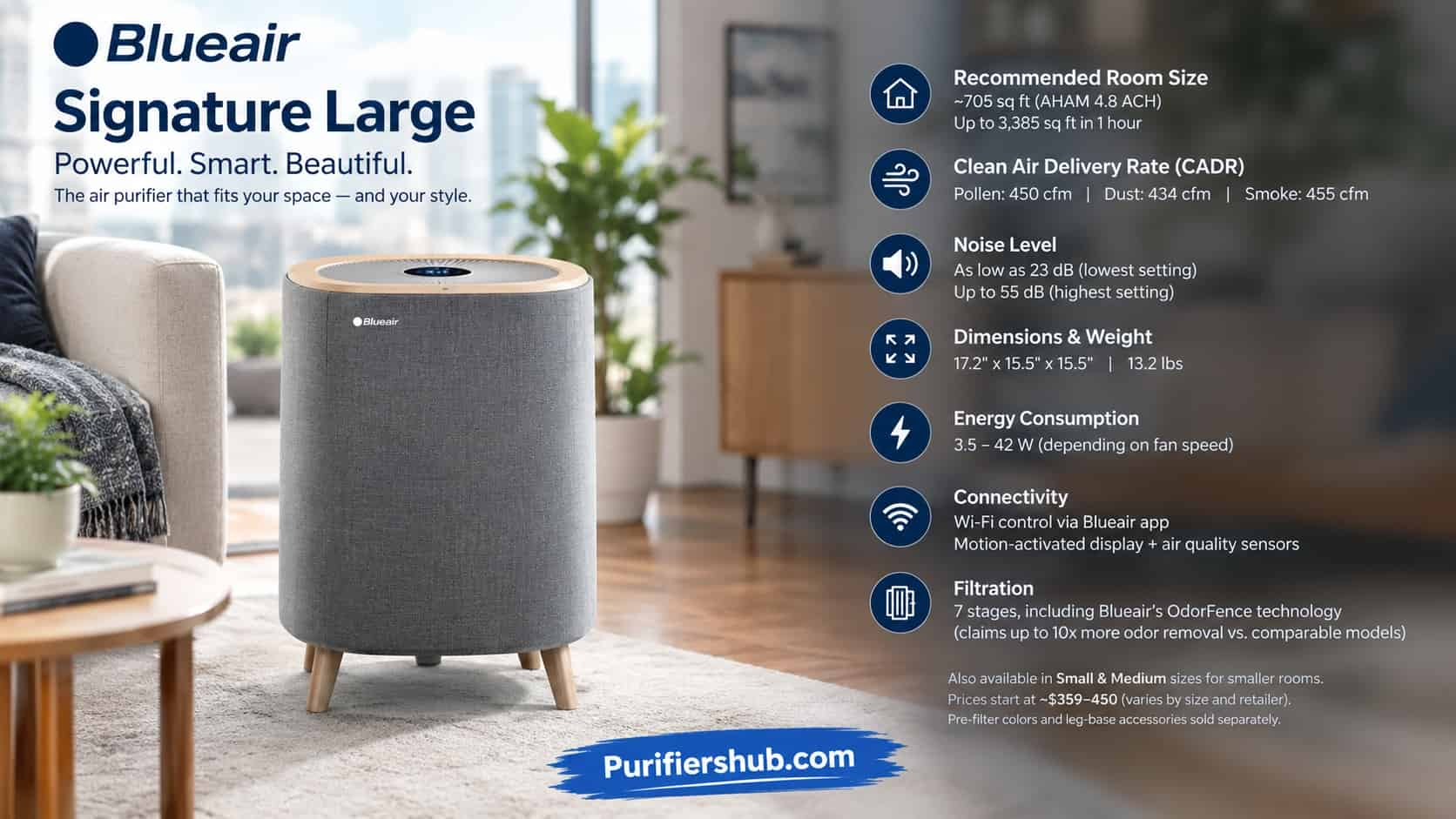
The Blue Signature Large is built for extra-large rooms and open floor plans. According to Blueair's published specifications:
- Recommended room size: approximately 705 sq ft at the AHAM-standard 4.8 air changes per hour, with a stated capacity to clean up to 3,385 sq ft in one hour
- Clean Air Delivery Rate (CADR): 450 cfm for pollen, 434 cfm for dust, 455 cfm for smoke
- Noise level: as low as 23 dB on the lowest setting, up to 55 dB on the highest
- Dimensions: 17.2" × 15.5" × 15.5"; weight: 13.2 lbs
- Energy consumption: 3.5–42 W depending on fan speed
- Connectivity: Wi-Fi control through the Blueair app, with a motion-activated display and integrated air quality sensors
- Filtration: 7 stages, including Blueair's OdorFence technology, which the company states removes up to 10 times more odor than comparable models in its testing
The Signature line's motion-activated, dynamic air quality display is a meaningful practical difference from older Blueair models. Rather than a simple color-coded light, it shows a live countdown to clean air based on the unit's current sensor readings, which gives a more concrete sense of how the purifier is responding to conditions in the room.
The standard Blue Signature (non-Large) is sized for smaller rooms, with a recommended coverage closer to 250–500 sq ft depending on the Small or Medium variant, lower CADR figures, and a correspondingly lower price. Pricing for the Signature series starts at roughly $359–450 depending on size and retailer.
Blue Pure 311i Max: A Mid-Size Alternative Worth Knowing
If the Signature Large is more purifier than a space needs, the Blue Pure 311i Max is Blueair's mid-size option and a common point of comparison. It is designed for rooms up to roughly 387–439 sq ft at the AHAM standard, with a CADR of 365 cfm for pollen, 314 cfm for dust, and 283 cfm for smoke.
Like the Signature line, it uses HEPASilent filtration with a washable fabric pre-filter, plus RealTrack — Blueair's in-app system for estimating remaining filter life based on actual usage and detected pollutant levels rather than a fixed calendar countdown.
The 311i Max is a reasonable middle ground for a living room, large bedroom, or home office, where a Signature Large would be oversized and a small bedroom unit would be undersized.
How Blue Signature, Signature Large, and 311i Max Compare
| Model | Room Size | CADR (Smoke) | Noise (Low–High) | Starting Price |
|---|---|---|---|---|
| Blue Signature Small/Medium | ~250–500 sq ft | 160–321 cfm | 19–54 dB | ~$300–360 |
| Blue Signature Large | ~705 sq ft | 455 cfm | 23–55 dB | ~$359–450 |
| Blue Pure 311i Max | ~387–439 sq ft | 283 cfm | — | ~$230 |
Figures are drawn from Blueair's published product pages. Confirm specifications on Blueair.com before purchasing, since models and pricing are updated periodically.
Does a Blueair Air Purifier Produce Ozone?
This question comes up often, and the honest answer has two parts. Blueair states that all of its air purifiers are CARB certified, meaning they are tested under California Air Resources Board standards and fall below the CARB ozone emission limit of 50 parts per billion. Testing is conducted at Intertek, an accredited third-party lab, using UL Standard 867. Blueair's Blue Pure Auto model specifically received a Zero Ozone Verification from Intertek in 2021, which is a stricter standard than general CARB certification.
The nuance worth understanding: CARB certification confirms a product does not exceed a safety threshold — which is not the same as a product emitting literally zero ozone. Because HEPASilent filtration uses an internal ionization step, some independent reviewers have pointed out that this is a meaningfully different design from a purely mechanical HEPA filter, even though testing shows the resulting ozone levels are far below the regulatory limit and are not considered a health concern at that level.
For anyone with specific sensitivity to ozone, it is reasonable to look at the Zero Ozone Verification documentation for the exact model under consideration rather than relying on the general CARB claim alone.
Blueair Filter Replacement: How Often and What It Costs
Blueair's official recommendation is to replace the main Particle and Carbon filter approximately every six months under typical use. App-connected models track actual filter life based on runtime and detected pollutant levels and will notify you through the Blueair app when a replacement is due, rather than relying on a fixed calendar.
Heavier use shortens that interval. Homes with pets, regular cooking odors, or nearby wildfire smoke exposure often need a replacement closer to every three to four months. The filter's internal light indicator or the app's RealTrack feature is a more reliable guide than a generic schedule, since it reflects your household's actual air quality conditions.
Replacement filters are sold directly through Blueair.com and through Amazon, with prices generally in the $20–50 range depending on the model. The main Particle and Carbon filter should never be washed or vacuumed — water and vacuum pressure both damage the filter media's structure and reduce its capture efficiency.
How to Clean a Blueair Air Purifier (Pre-Filter and Housing)
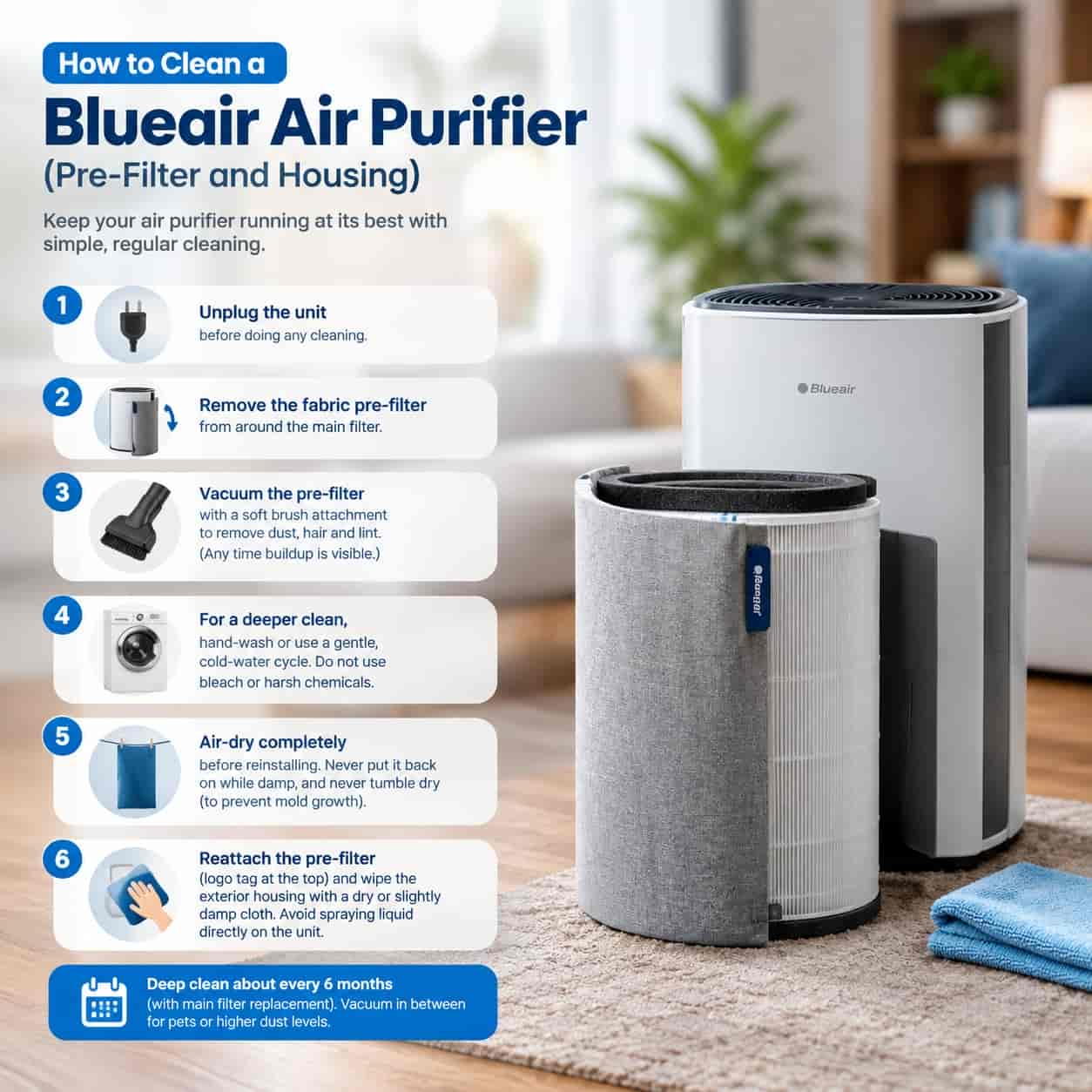
Unlike the main filter, the fabric pre-filter that wraps around most Blueair units is washable and designed to be reused for the life of the purifier. Follow these steps:
- Unplug the unit before doing any cleaning.
- Remove the fabric pre-filter from around the main filter.
- For routine maintenance, vacuum the exterior of the pre-filter with a soft brush attachment to remove visible dust, hair, and lint.
- For a deeper clean, hand-wash the pre-filter or wash it in a washing machine on a gentle, cold-water cycle. Do not use bleach or other harsh chemicals.
- Air-dry the pre-filter completely before reinstalling it. Never put it back on the unit while damp, and never tumble dry it.
- Reattach the pre-filter so the Blueair logo tag sits in the correct upper position, then wipe down the exterior housing with a dry or slightly damp cloth.
Blueair recommends this deep-clean wash roughly in sync with each main filter replacement — about every six months — with lighter vacuuming in between for households with pets or higher dust levels.
Build Quality and Certifications
Most Blueair units use a steel outer body rather than an all-plastic housing, and the company states its filter materials are biodegradable and that unit components are recyclable. Blueair models are also AHAM Verified, meaning their CADR ratings are tested and confirmed by the Association of Home Appliance Manufacturers using a standardized method, which makes room-size recommendations more directly comparable across brands.
Several models, including units in the Blue Pure Max and Signature lines, also carry the Energy Star rating for energy efficiency. AHAM Verified CADR figures in particular are a more reliable basis for comparison shopping than marketing copy alone, since the testing methodology is standardized rather than brand-specific.
Choosing the Right Blueair Model for Your Space
The clearest way to pick between Blueair models is to start with square footage rather than price or features. Measure the room, then match that number against the AHAM-standard recommended room size Blueair publishes for each model — rather than the maximum one-hour coverage figure, which reflects a best-case scenario at full fan speed.
- Large open-plan living area or primary bedroom: Blue Signature Large or Blue Pure Max
- Typical bedroom, home office, or mid-size living room: Blue Pure 311i Max or Blue Signature Medium
- Nursery or small bedroom: Blue Signature Small or a compact Blue Pure model
Households managing specific concerns — pet dander, seasonal allergies, or cooking odors — should also check that the model under consideration includes the carbon layer in its filter, since particle-only filtration will not meaningfully reduce odors. See our HEPA air purifier category for a broader comparison of models across brands.
Limitations to Know Before You Buy
A HEPASilent filter, like any HEPA-based filter, captures airborne particles but does not disinfect surfaces, treat an existing illness, or eliminate the need for source control measures such as fixing a mold problem or improving ventilation. The U.S. EPA's guidance on residential air cleaners describes filtration as an effective supplement to source control and ventilation, not a replacement for either.
Blueair does not claim that its purifiers prevent the transmission of airborne illness, and no manufacturer's claim about allergy or asthma relief should be read as a medical guarantee. Anyone managing a diagnosed respiratory condition should treat an air purifier as one part of an indoor air quality strategy and discuss specific concerns with a healthcare provider. Browse our air purifier reviews to compare models across brands.
FAQ
Does a Blueair air purifier produce ozone?
Blueair states that all of its models are CARB certified and tested below the California Air Resources Board's 50 ppb ozone limit using Intertek testing under UL Standard 867. This confirms the units stay within a certified safety threshold, which is a different claim from producing literally zero ozone, since HEPASilent filtration uses an internal ionization step.
How often should I replace the filter on a Blueair air purifier?
Blueair's official guidance is approximately every six months under typical use. Homes with pets, frequent cooking odors, or wildfire smoke exposure often need replacement closer to every three to four months. App-connected models track actual usage and will notify you when a replacement is due.
Can I wash the main HEPA filter on a Blueair purifier?
No. Only the fabric pre-filter is washable. The main Particle and Carbon filter should never be washed or vacuumed, since water and vacuum pressure damage the filter media and reduce its effectiveness.
What room size does the Blue Signature Large cover?
Blueair recommends the Signature Large for rooms around 705 sq ft at the AHAM-standard 4.8 air changes per hour, with a stated maximum coverage of up to 3,385 sq ft in one hour at full fan speed.
Is the Blue Pure 311i Max powerful enough for a large living room?
It depends on the room's size. The 311i Max is rated for rooms up to roughly 387–439 sq ft at the AHAM standard. For an open-concept living and dining area larger than that, a Blue Signature Large or similarly sized Blue Pure Max model is a better match.
What's the difference between Blue Signature and Blue Signature Large?
Both share the same HEPASilent filtration and feature set. The difference is size and coverage: Signature Small and Medium are built for smaller rooms with lower CADR ratings and a lower price, while Signature Large is built for extra-large rooms and open floor plans.